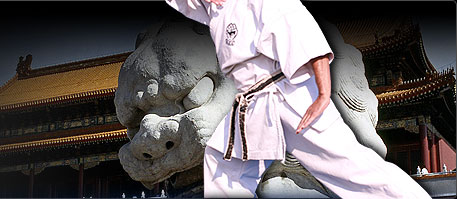
Katas are a sequence of pre-defined movements that include the attack and defence against one or more imaginary attackers. They are practised alone to perfect the movements and to learn how to move more efficiently. Many katas contain karate techniques that are not obvious to an onlooker (and sometimes not even to the student performing the kata). The practical application of the katas is called Bunkai. Katas and their applications are an integral part of the grading system. There are twelve katas in the Goju-Ryu Kata List and they are divided into two main groups: Kaishugata and Heishugata. The Kaishugata comprise Gekisai-Dai-Ichi, Gekisai-Dai-Ni, Saifa, Seiunchin, Shisochin, Sanseru, Sepai, Sesan, Kururunfa and Suparinpei. The Heishugata comprise Sanchin and Tensho.
Kaishugata Group
GEKISAI-DAI-ICHI & GEKISAI-DAI-NI
Gekisai means "to destroy or demolish". These katas were created by Chojun Miyagi and are designed for beginners. They contain exaggerated movements and are relatively easy to learn.
|
SAIFA
Saifa means, "tearing" and is of Naha-te origin. It is also known as "Circle/Circular" kata |
SEIYUNCHIN
Seiyunchin is said to "mean marching far quietly" or "pulling" and is also known as the "Earth" or "Dragon" kata. It is of Chinese origin. |
SHISOCHIN
Shisochin means, "fighting four" and refers to fighting in four directions and is of Chinese origin having been taught to Kanryo Higoanna by Ryu Ryu Ku.
|
SANSERU
Sanseru when written in Chinese characters is the number 36. It also focuses on fighting in all four directions. |
SEPAI
Sepai is the number 18. It is of Chinese origin. |
KURURUNFA
Kururunfa means seventeen or holding your ground featuring shifting the body (evasive manoeuvers). It is also of Chinese origin. |
SEISAN
Seisan means "thirteen hands". It contains eight defensive and five offensive moves. |
SUPERINPEI
Suparinpei is the number 108 and is said to refer to a warrior group of 108 men who, in the 1600's travelled the countryside righting wrongs - Robin Hood style. |
|
 |